Disposal Blog
Data Destruction During Office Clearance in Zurich: DSG Compliance
Learn how DSG-compliant office clearance handles hard drives, backup tapes and confidential files in Zurich.
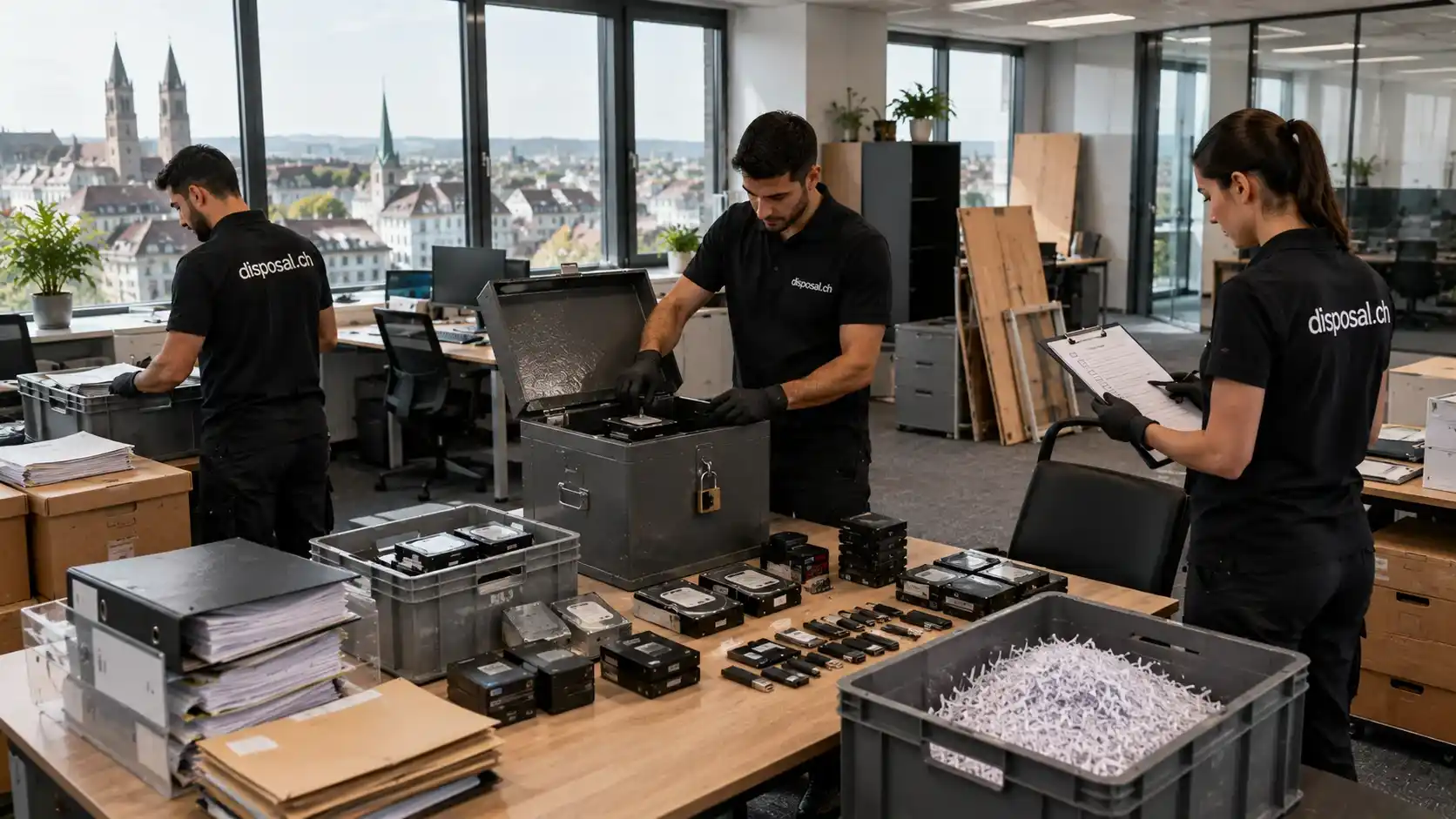
An office clearance moves out far more than desks and filing cabinets. Old hard drives, forgotten USB sticks, a decade of backup tapes in a storage cupboard, and the internal storage inside a decommissioned printer all still hold data, and under the Swiss Datenschutzgesetz (DSG), getting rid of that data carelessly is a genuine compliance risk, not just an oversight.
This guide explains what DSG-compliant data destruction actually requires during an office clearance in Zurich, which devices are commonly forgotten, how the ISO/IEC 21964 destruction standard works in plain terms, and how certified destruction fits into a single clearance visit rather than a separate headache.
Why Data Destruction Can't Be an Afterthought
Deleting files or formatting a drive doesn't actually remove the underlying data. Specialists can recover "deleted" information from a drive in a lab with the right tools, which is exactly why the only genuinely secure method is physical destruction of the storage medium itself. Under the DSG, businesses remain responsible for personal and business data even after equipment leaves the office, which makes proper destruction, not just disposal, a real legal obligation.
What Counts as a Data Carrier in an Office Clearance
• Desktop and laptop hard drives and SSDs
• USB sticks, external drives, and memory cards
• Backup tapes and old server storage
• CDs, DVDs, and other optical media
• Printer and copier internal hard drives, genuinely easy to overlook, since most A3 and many A4 multifunction devices store scanned and printed document data internally
• Physical documents and files containing personal or confidential business data
Key Takeaway
The printer sitting in the corner is very often the most overlooked data carrier in an office clearance. If it has ever scanned or printed a confidential document, its internal storage needs the same treatment as a computer hard drive.
The Standard That Actually Matters: ISO/IEC 21964
Certified data destruction in Switzerland follows ISO/IEC 21964 (the successor to the older DIN 66399 standard), which defines destruction requirements by protection class and security level, based on how sensitive the data is and what physical form the carrier takes.
|
Protection Class |
Data Sensitivity |
Example |
|
Class 1 |
Normal protection for internal data |
General internal correspondence |
|
Class 2 |
High protection for confidential data |
HR records, client contracts |
|
Class 3 |
Very high protection for secret data |
Financial data, medical or highly sensitive personal data |
Within these classes, specific security levels define the physical destruction requirement for each medium, for example, magnetic hard drives destroyed to a maximum particle size of roughly 2,000 mm² under level H-4, and flash storage such as SSDs and USB sticks reduced to a far smaller 30 mm² under level E-4, reflecting how much more data can be packed into a small piece of flash memory.
Physical Documents Need the Same Care
Paper files aren't exempt. Business records in Switzerland are also subject to statutory retention periods under the Geschäftsbücherverordnung (GeBüV), meaning some documents legally cannot be destroyed yet, even during an office clearance, while others are well past their retention date and should be destroyed rather than simply recycled as ordinary paper waste.
The Certificate of Destruction: Your Compliance Proof
Certified destruction should always come with a certificate of destruction, documenting what was destroyed, when, and to what security level. This isn't paperwork for its own sake, it's the evidence a business needs to demonstrate DSG compliance during an audit or in the event of a data protection query.
How This Fits Into an Office Clearance
Data destruction works best as part of the same visit as the rest of the office clearance, not a separate appointment. A well-run process typically includes secure collection, often using lockable containers and tracked transport, sorting by device type and protection class, and certified destruction with documentation, all coordinated alongside the removal of furniture, fixtures, and general office contents.
The disposal.ch Approach
disposal.ch coordinates DSG-compliant data destruction directly within a fixed-price office or business clearance, working with certified partners so hard drives, backup media, and old files are destroyed to the correct standard while the rest of the space is cleared in the same visit. A photo sent on WhatsApp gets a quote confirmed within the hour, and any remaining electronics are routed through certified e-waste recycling once data-bearing components have been properly destroyed.
A Real-World Scenario
A company relocating offices discovers an old server cabinet, several boxes of client files past their retention date, and a decommissioned photocopier still holding scanned documents internally. A single coordinated clearance visit handles the furniture removal, certified data destruction with documentation, and responsible e-waste recycling, all in one appointment.
Conclusion
Data destruction during an office clearance is a genuine DSG obligation, not an optional extra, and it covers more than the obvious computer hard drives, backup tapes, old files, and even printer internals all need proper handling. Following the ISO/IEC 21964 standard with a documented certificate of destruction gives a business real compliance proof, and coordinating this within a single clearance visit removes the need for a separate, disconnected process.
Get a fixed-price quote for your office clearance and data destruction in Zurich today, send us a photo on WhatsApp and we'll confirm your price within the hour. Book your fixed-price clearance here.
Frequently Asked Questions
Is deleting files or formatting a drive enough for DSG compliance?
No. Deleted or formatted data can often be recovered with specialist tools. Physical destruction of the storage medium is the only genuinely secure method under DSG requirements.
Do printer and copier hard drives need to be destroyed too?
Yes. Many multifunction printers and copiers store scanned and printed document data internally, and this internal storage needs the same certified destruction as a computer hard drive.
What standard governs data carrier destruction in Switzerland?
ISO/IEC 21964, which defines protection classes and security levels based on data sensitivity and carrier type, is the standard certified destruction partners work to.
Can old business documents always be destroyed during a clearance?
Not always. Some records are still within their statutory retention period under the Geschäftsbücherverordnung (GeBüV) and legally cannot be destroyed yet, so files should be checked before disposal.
Does data destruction happen separately from the office clearance?
Not with disposal.ch. Certified data destruction is coordinated within the same fixed-price clearance visit, alongside furniture removal and e-waste recycling.
